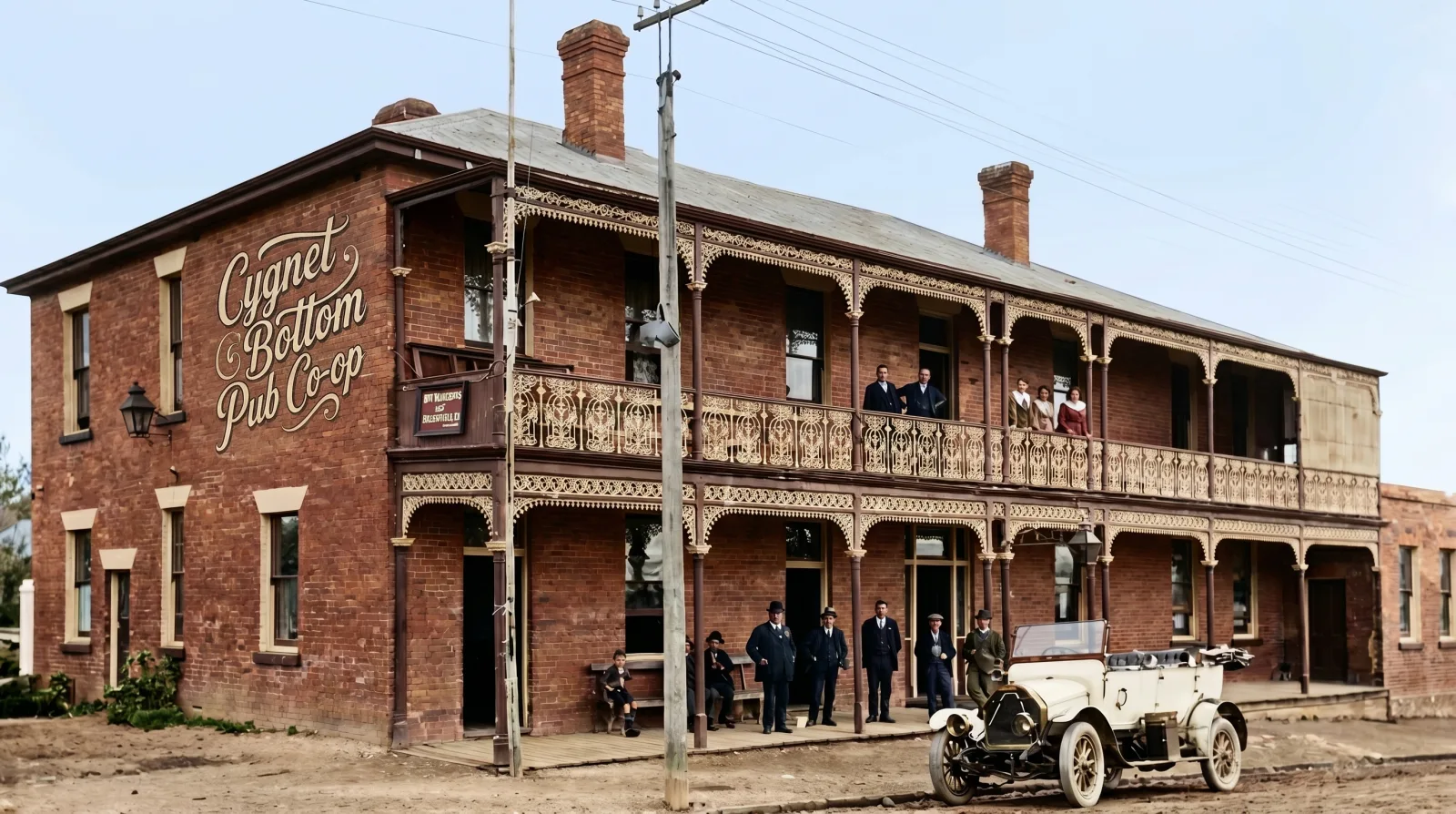
The campaign is over. The record remains.
The Bottom Pub is now under contract, and the working group's campaign concluded there. The wider project is now closed, and this site remains online as a civic record of what Cygnet tried, learned and said it valued.
A co-operative formation meeting was scheduled for 23 August 2026. This archive does not record whether it went ahead or what it decided, and makes no claim that a co-operative or board resulted. The Bottom Pub Project itself is now closed.
A place worth pausing over.
The Bottom Pub had been closed for some time, and its future was unclear. Places like this are more than businesses. They are gathering places, local employers, and part of what makes a town feel like itself — so a working group asked whether Cygnet could buy it together.
On 13 August 2026 that offer was unsuccessful, and the pub went under contract to another buyer whose identity is not public. The acquisition campaign concludes there. What it produced along the way — research, a community survey, and the groundwork for a co-operative that could exist independently of any one building — did not.
“Could Cygnet explore a different path — and decide, together, whether this place is worth keeping?” — A question, not a campaign
Section · 02 · What we learned
What Cygnet told us.
In 2026 a community campaign tried to buy the Bottom Pub, and people in and around Cygnet answered its forms in numbers. The bid did not succeed. The evidence is too useful to lose — so here is what people actually said, with the arithmetic shown.
- 145 financial-survey responses
- 32 community-survey responses
- 58 expressions of interest
- + a register of non-binding pledges
Self-selected instruments, June – August 2026; not a representative poll of Cygnet. Every count is fixed to the analysis window for each instrument — financial survey 3–28 June 2026, community survey 3 June 2026 – 23 July 2026, and the expression-of-interest register as frozen at 58 submissions — verified and reproduced on 20 August 2026. The community survey is closed; responses after 23 July 2026 are not in this edition.

II The field, and the exception
Financial survey · 3–28 June 2026 · n=145
People engaged with the money question shared most of their worries. Grant co-funding was the largest difference.
145 people completed the financial survey. 90 of them are linkable by exact email address to an entry on the pledge register; 55 are not. Pledges were explicitly non-binding and no money was ever collected — a pledge here is a signal of willingness, not a payment.
Lay every condition both groups ticked along one axis — more common among pledge-linked respondents to the right, more common among the rest to the left — and most sit close to the centre line: a business plan, an asset lock, a building inspection, transparency about risks were asked for at similar rates by both groups. A few lean one way or the other. Pledge-linked respondents asked for clear governance and an experienced publican somewhat more often; the rest asked for evidence of community support somewhat more often. Grant co-funding is the largest difference. Respondents linkable to a pledge were twice as likely to make external grant money a condition (28.9% against 14.5%) — still a minority in both groups. Read plainly: where the two groups differed most, it was over whether outside grant money was required, not over whether to take part.
Eleven conditions, placed by how differently the two groups asked for them.
- 1 Clear governance 80.0% / 69.1%
- 2 A credible business plan 71.1% / 65.5%
- 3 An asset lock 60.0% / 58.2%
- 4 Transparency about risks 58.9% / 61.8%
- 5 The legal structure settled 56.7% / 58.2%
- 6 A building inspection 56.7% / 54.5%
- 7 An experienced publican 56.7% / 49.1%
- 8 Evidence of community support 52.2% / 61.8%
- 9 An independent valuation 41.1% / 40.0%
- 10 Grant co-funding 28.9% / 14.5%
- 11 A community meeting first 27.8% / 32.7%
- pledge-linked, n=90
- no linked pledge, n=55
- one condition — its pair is printed as pledge-linked % / no-linked-pledge %
- thread thickness = that group's percentage
How to read it. Left–right is the percentage-point difference between the two groups; the dotted line is zero. Up–down is how many of all 145 respondents ticked the condition. Each condition is joined to both groups by a thread whose thickness is that group's rate — two thick threads of equal weight mean a widely shared condition.
These are two shades of engagement, not two camps: everyone here filled in a detailed financial survey, and anyone uninterested is in neither group. The threads show shared attention, not influence, movement or a social network, and a percentage-point difference carries no causal direction. At these group sizes small differences should not be over-interpreted; the finding is the pattern — one large difference, a few modest leans, and most conditions near the line.
III The full audit
Every option, both groups, one axis
All twenty options, so you can check the claim yourself.
The financial survey offered eleven conditions and nine information needs as structured tick-boxes. Here is every one of them: each row shows both groups' rates on the same 0–100% axis, pledge-linked first in the printed pair. The pattern above should be visible here too — small gaps almost everywhere, a few modest leans, one large one.
All twenty structured options, both groups, on one shared 0–100% axis.
- pledge-linked, n=90
- no linked pledge, n=55
- printed pair = pledge-linked % / no-linked-pledge %
Rows are ordered by the pledge-linked rate within each group of options — a declared ordering, not a data channel. The faint banding is for the eye only. Dot size and connector weight are constant; the only quantities on this chart are the two positions on the axis.
The same twenty rows as a table, with raw counts
| Option | Pledge-linked (of 90) | No linked pledge (of 55) | All 145 |
|---|---|---|---|
| Clear governance | 72 (80.0%) | 38 (69.1%) | 110 (75.9%) |
| A credible business plan | 64 (71.1%) | 36 (65.5%) | 100 (69.0%) |
| An asset lock | 54 (60.0%) | 32 (58.2%) | 86 (59.3%) |
| Transparency about risks | 53 (58.9%) | 34 (61.8%) | 87 (60.0%) |
| The legal structure settled | 51 (56.7%) | 32 (58.2%) | 83 (57.2%) |
| A building inspection | 51 (56.7%) | 30 (54.5%) | 81 (55.9%) |
| An experienced publican | 51 (56.7%) | 27 (49.1%) | 78 (53.8%) |
| Evidence of community support | 47 (52.2%) | 34 (61.8%) | 81 (55.9%) |
| An independent valuation | 37 (41.1%) | 22 (40.0%) | 59 (40.7%) |
| Grant co-funding | 26 (28.9%) | 8 (14.5%) | 34 (23.4%) |
| A community meeting first | 25 (27.8%) | 18 (32.7%) | 43 (29.7%) |
| The total capital required | 61 (67.8%) | 35 (63.6%) | 96 (66.2%) |
| How the co-op model works | 53 (58.9%) | 32 (58.2%) | 85 (58.6%) |
| What happens to money if it fails | 49 (54.4%) | 29 (52.7%) | 78 (53.8%) |
| The timeline | 43 (47.8%) | 33 (60.0%) | 76 (52.4%) |
| How decisions would be made | 43 (47.8%) | 33 (60.0%) | 76 (52.4%) |
| Who runs it day to day | 38 (42.2%) | 24 (43.6%) | 62 (42.8%) |
| A risk assessment | 34 (37.8%) | 27 (49.1%) | 61 (42.1%) |
| Case studies of other co-ops | 33 (36.7%) | 20 (36.4%) | 53 (36.6%) |
| Whether there would be returns | 32 (35.6%) | 21 (38.2%) | 53 (36.6%) |
Data: cohort-findings.json — counts, denominators and provenance, no respondent-level records. Both figures are drawn from that file when the site is built; nothing on this page is fetched.
IV What else people said
Community survey · 32 responses · open questions, coded
Beyond the money question: what people liked, wanted, and would offer.
A separate, shorter community survey asked open questions. Answers were coded into themes under a written codebook and counted as people, not mentions. One mark per respondent: a filled mark raised the theme, a faint mark answered the question without raising it, and an empty ring did not answer at all. Counts are shown as counts — at these sizes a percentage would promise precision the evidence does not have.
- raised this
- answered without raising it
- did not answer the question
Community survey · 24 of 32 answered
What people liked most about the pub
Respondents were asked which facets of the Commercial pub they liked most, and could select as many as applied. 24 of 32 answered.
- Food and beverage 20
What was served was the most commonly selected thing people liked.
20 raised this · 4 answered without raising it · 8 did not answer
- The ambience and layout 14
How the building felt to be in was selected as often as its staff.
14 raised this · 10 answered without raising it · 8 did not answer
- Staff and ownership 14
The people behind the bar were valued as much as anything on it.
14 raised this · 10 answered without raising it · 8 did not answer
- Events or specials 6
A smaller group valued what the pub put on rather than its day-to-day trade.
6 raised this · 18 answered without raising it · 8 did not answer
Accommodation was selected by fewer than five people, so it is not shown with a count here.
Community survey · 27 of 32 answered
What people wanted improved
Respondents were asked what would have made their experience of the pub better. This was an open question. 27 of 32 answered.
- Outdoor seating and a beer garden 14
More than any other single request, people wanted to be able to sit outside — a beer garden, seating away from the road, and use of the open ground behind the building.
14 raised this · 13 answered without raising it · 5 did not answer
- Food and a changing menu 10
People wanted the kitchen to do more with what grows locally, and a menu that changed with the seasons rather than staying fixed.
10 raised this · 17 answered without raising it · 5 did not answer
- Interior comfort and layout 9
Responses described the inside as fragmented or dark, and asked for comfortable seating, better light, and spaces where small groups could sit together.
9 raised this · 18 answered without raising it · 5 did not answer
- A wider drinks range 7
Responses asked for local and craft options behind the bar, and for non-alcoholic drinks beyond pre-packaged ones.
7 raised this · 20 answered without raising it · 5 did not answer
- Somewhere dogs are welcome 6
A clearly recurring request was for the pub, or part of it, to be a place people could bring a dog.
6 raised this · 21 answered without raising it · 5 did not answer
- Live music 5
People asked for live music, and several specified regularly rather than occasionally.
5 raised this · 22 answered without raising it · 5 did not answer
Fewer than five responses each — so not shown with a count — also asked for the fireplace to be cleaned, enlarged or simply lit, and for fire pits outside. Practical complaints — the toilets, wifi, and being able to book without telephoning — were also raised by fewer than five responses. Others raised upgrading the accommodation, an online booking system, somewhere for community groups to meet, enclosed space for children, and a screen for watching sport. One response argued the site would serve Cygnet better as a community centre than as a pub at all.
Community survey · 26 of 32 answered
Events and activities people wanted
Respondents were asked what events or activities they would like to see at the pub. 26 of 32 answered.
- Live music 16
Live music was the most frequently named activity, and several responses asked for local performers specifically.
16 raised this · 10 answered without raising it · 6 did not answer
- Trivia and quiz nights 10
A regular quiz was the second most commonly named activity, often described as something people would attend weekly.
10 raised this · 16 answered without raising it · 6 did not answer
- Open mic and performance 7
Responses asked for nights where people from the community perform rather than only watch.
7 raised this · 19 answered without raising it · 6 did not answer
- Community meals 5
People described eating together as an event in itself, from pizza nights to shared dinners at large tables.
5 raised this · 21 answered without raising it · 6 did not answer
- Markets 5
Several responses saw the site and its grounds as a better home for a regular market.
5 raised this · 21 answered without raising it · 6 did not answer
- Talks and workshops 5
People suggested the pub as a place to hear from and learn from others in the community.
5 raised this · 21 answered without raising it · 6 did not answer
Fewer than five responses each also asked for film screenings, indoors and outdoors, and for games nights — board games, cards, pool and table tennis. Others raised weddings and family functions, food and drink tastings, a locals' rewards club, seasonal celebrations, children's discos, community dances, and somewhere young people could call theirs.
Community survey · 24 of 32 answered
What people would add to the building
Respondents were asked what other additions they would like to see — facilities, services and physical improvements. 24 of 32 answered.
- A covered beer garden 10
A sheltered outdoor area was the most commonly named addition — several responses noted that Cygnet's weather makes cover essential.
10 raised this · 14 answered without raising it · 8 did not answer
- A general upgrade of facilities 5
Responses asked for the basics to be brought up to standard — bathrooms, lighting, and the general condition of the building.
5 raised this · 19 answered without raising it · 8 did not answer
Most additions people named were raised by fewer than five respondents, so only two are shown with counts. Those not counted here include better and more varied overnight accommodation, fire pits, barbecues and a pizza oven, a function or meeting room, a kitchen garden growing produce for the pub, and enclosed space where children and dogs could be safe. Individual responses also raised secure storage for visiting cyclists and motorcyclists, solar power and electric-vehicle charging, a wedding venue, food trucks, moving the drive-through bottle shop, and rooms equipped for classes and skill-sharing.
Community survey · 24 of 32 answered
What community needs the place could serve
Respondents were asked what Cygnet needs that does not have a home, given the building's rooms, kitchen and carpark. 24 of 32 answered.
- Meeting rooms for community groups 9
The most frequently raised need was somewhere for groups to meet — several responses noted that small and medium meeting rooms are hard to find in Cygnet.
9 raised this · 15 answered without raising it · 8 did not answer
Only one need here was raised by five or more people, so this section is mostly uncounted. The need named next most often was somewhere for young people to gather, raised by four respondents — one short of the threshold for publishing a count, though young people were also the most frequently named priority for any future surplus. Other needs raised by small numbers include training and skills, particularly hospitality skills for young people; desks or a co-working room for people who work from home; use of the commercial kitchen to support local food services and teach cooking; and emergency accommodation. Individual responses also raised a community garden, affordable and backpacker accommodation, rooms for performers during the Folk Festival, a quiet room for reading or a book club, and a games room. Some responses questioned the premise: they argued a licensed venue is the wrong setting for young people or for emergency accommodation, and that meeting rooms already exist elsewhere in Cygnet.
Community survey · 18 of 32 answered
Other ideas people contributed
An open question inviting anything else, sensible or wild. 18 of 32 answered — the lowest response rate of any question here.
- Tool, seed and produce sharing 6
The most common suggestion was some form of sharing library — tools, seeds or surplus produce — though other responses argued Cygnet already has these and that they need someone to look after them.
6 raised this · 12 answered without raising it · 14 did not answer
A regular market or other recurring event at the site was also raised by fewer than five respondents. Individual responses also suggested a seed library, a community fridge or pantry, a book and clothes-mending swap, a noticeboard, a large solar array with vehicle charging, encouraging touring cyclists and motorcyclists, displaying local history, a pop-up arts space, a quiet room, auction nights, and becoming a demonstration site for practical sustainability. Several of these ideas were also explicitly argued against by other responses, on the grounds that Cygnet already has them or that they need someone to maintain them.
Community survey · 25 of 32 answered
If there had been a surplus, where did people hope it might go?
25 of 32 respondents answered this hypothetical question. They were describing priorities they would value if a community-owned enterprise ever generated surplus — not commitments, funding decisions, or expectations of the pub's next owners.
- Young people 7
Responses repeatedly named young people — activities, training, and help seeing a future locally.
7 raised this · 18 answered without raising it · 7 did not answer
- Health services 6
General health and medical services in Cygnet were named by several responses.
6 raised this · 19 answered without raising it · 7 did not answer
- Mental health support 6
Mental health support was among the most frequently named priorities.
6 raised this · 19 answered without raising it · 7 did not answer
Smaller numbers of responses also named animal welfare, care of Agnes Creek and the waterway into Port Cygnet, homelessness services, support for older residents, disability and carer support, food security, housing, literacy and numeracy support, a local scholarship, and improvements to shared facilities in the town. Support for families, parents and carers, and emergency relief for people in immediate difficulty, were each named by four or fewer respondents and so are not shown with counts.
Community survey · 32 of 32 answered
What success in twenty years looked like
Respondents were asked to imagine the pub in twenty years and select what success would look like, choosing as many as applied. All 32 answered.
- An anchor for Cygnet's cultural life 19
The most commonly chosen vision was cultural rather than commercial.
19 raised this · 13 answered without raising it · 0 did not answer
- Local jobs and local producers 18
Work and local supply chains were chosen almost as often.
18 raised this · 14 answered without raising it · 0 did not answer
- Still open when others have closed 16
Simple survival was chosen by around half of those who answered.
16 raised this · 16 answered without raising it · 0 did not answer
- Somewhere everyone still feels welcome 15
Who the place is for mattered as much as what it does.
15 raised this · 17 answered without raising it · 0 did not answer
- A heritage building preserved 15
The building itself, not only its use, was part of what people wanted kept.
15 raised this · 17 answered without raising it · 0 did not answer
- A destination for visitors 14
Drawing people to the Valley was chosen almost as often as community pride.
14 raised this · 18 answered without raising it · 0 did not answer
- A source of community pride 13
Pride and resilience were named as outcomes in their own right.
13 raised this · 19 answered without raising it · 0 did not answer
- Proof community ownership can work 11
Around a third chose demonstrating that community ownership is viable.
11 raised this · 21 answered without raising it · 0 did not answer
- A training ground for young workers 11
Training the next generation of hospitality workers was chosen by around a third.
11 raised this · 21 answered without raising it · 0 did not answer
- Helped keep young people here 8
Keeping young people in the region was chosen by around a quarter.
8 raised this · 24 answered without raising it · 0 did not answer
- A model other towns learn from 8
A smaller group hoped the effort would be useful beyond Cygnet.
8 raised this · 24 answered without raising it · 0 did not answer
- Supported community groups 6
Supporting other local groups was the least commonly chosen option.
6 raised this · 26 answered without raising it · 0 did not answer
One response wrote its own answer rather than choosing from the options. It measured success by whether the surrounding community kept developing — whether fresh thinking kept arriving and whether emerging local needs were being answered.
Offers of help · expression-of-interest form · 58 submissions
What people offered to bring.
58 expression-of-interest submissions ticked the skills being offered. One mark per submission: strong marks offered that skill, faint marks did not. These are recorded offers on one form — not an audit of what Cygnet can do. A blank row means nobody happened to offer it here, not that the capability is absent from the town.
- Food and garden 9
- Hospitality 8
- Community work 6
- Communications 5
- Operations 5
- Legal 0
No recorded offer at all — worth stating because a community-owned venture needs legal work early and often, so this is capacity that would have to be bought or recruited.
Five further skill areas were each offered by fewer than five people, so they are described without counts under the site's disclosure rule. Two of them — administration and other — are named; the labels of the remaining three are withheld because each maps onto a role already attached to a publicly named person, and naming the category would invite inference about their participation.
Two conditions ticked by around half the financial survey — a settled legal structure and an experienced publican — sit exactly where recorded offers are thinnest. The offers lean toward labour and goodwill: gardens, service, organising, communications. A hospitality or operations tick is a willing pair of hands, not a professional pub manager, and no legal capacity was recorded at all. Whoever takes this forward inherits that gap.
V Boundaries
What this evidence cannot tell you
Five things this page does not know.
- It cannot measure opposition. People who dislike an idea mostly do not fill in its forms. Low observed opposition is indistinguishable from opposition that never participated.
- The pledge link is a floor, not a fact about people. Linkage is by exact email match only. Someone who pledged under a different address counts here as having no linked pledge, so the 90 is a lower bound and the two groups are exact-email cohorts, not verified sets of people.
- A pledge was never money. Pledges were explicitly non-binding and no money was collected. Nothing on this page says who would actually have paid.
- Nothing here is causal. The survey and the pledge register are two instruments answered by an overlapping, self-selected crowd. A gap between the groups describes the crowd; it does not explain it.
- Instruments don't mix. The community survey (32), the financial survey (145) and the expression-of-interest form (58) asked different people different questions. Every chart keeps its own denominator, and this page never adds across them.
For whoever owns the Bottom Pub next
We didn't get to buy the pub. But hundreds of responses across three instruments — counted as responses, not people, since the same person could answer more than one — said what people valued about it, what they would need to see before backing a community version of it, and what they could offer. This isn't a representative poll, and it isn't a list of demands. It is simply evidence that seemed too useful to leave sitting in a database.
- Support, where it existed, was conditional — and the conditions are consistent.Clear governance, a credible business plan, an asset lock, a building inspection, a settled legal structure. The same floor appears on both sides of the pledge line. Any future community venture here inherits that list as its first to-do list.
- Where the two groups differed most, they differed about outside money.Grant co-funding showed the largest gap between the groups: 26 of the 90 respondents linkable to a pledge made it a condition (28.9%) against 8 of 55 who were not (14.5%) — roughly twice as likely, though a minority requirement in both groups. Among those who did set it, community contributions were imagined as part of a funding mix rather than the whole of one.
- People cared about how the place felt.Warmth, comfort, light and layout recur alongside the food and the drinks list. When people described what would bring them back, they described a feeling as often as a product.
- Sitting outside was the most common single request.A beer garden and use of the open ground behind the building were named by 14 of the 27 people who answered the question about what would have improved their experience — more than any other single request, ahead of food and a changing menu on 10. Several noted that Cygnet weather means cover matters.
- People wanted reasons to turn up on a particular night.Live music and a regular quiz were named far more often than anything else, and several described them as things they would attend weekly rather than occasionally.
- The building was imagined as more than a hospitality venue.Rooms that community groups could use came up repeatedly, as did somewhere for young people to be. Both were framed as things Cygnet lacks rather than things the pub owes anyone.
- Offers of help were generous, practical — and thin in the professional layer.Food and garden work, hospitality, community organising and communications were all volunteered. No one recorded an offer of legal capacity through the expression-of-interest form. That is a statement about what was offered, not about who lives here.
- Not everyone agreed, and that is in here too.Some responses argued a licensed venue is the wrong setting for young people or for emergency accommodation, and that meeting rooms already exist elsewhere in town. Those views are recorded alongside the rest.
Whatever happens next, we hope this helps.
The work remains available.
Pledges, surveys and registrations are closed. The research, public documents and de-identified findings remain available for anyone who wants to learn from the attempt.
A finished project, kept legible.
The public archive preserves the proposal, the evidence behind it, the questions it raised and the post-mortem of why the offer did not succeed.
The co-operative page is retained as a record of the proposed model, not a live formation process. For corrections to this record or questions about its methods, write to the maintainer.
Everything, as found.
The working documents behind the campaign — research, drafts, and the questions that came up along the way — are published as found in the campaign archive. A post-mortem sets out what worked, what didn't, and why. Ongoing updates and press coverage continue to be posted as they happen.
Locals gathered at the Town Hall to talk through the co-op idea. The campaign concluded on 13 August 2026.
The community met. People asked the hard questions: how a co-op could work, how money might be raised, what state the building is in, and what could go wrong. A full transcript is available.